 Adding item to the basket...


This is a carousel. Use the previous and next buttons to navigate.
How to Design Festive Lighting for Different Spaces
A festive lighting scheme should feel as though it belongs in its surroundings. A narrow historic street, a wide high street and an open town square all offer very different opportunities, and the same approach won't necessarily work equally well in each.
Before choosing products, it's worth looking at the space itself: its size, architecture, existing infrastructure, how people move through it and what you want the finished scheme to achieve.
By considering these factors from the beginning, even relatively simple lighting installations can have a much greater impact.
The first step in designing a festive lighting scheme is understanding the space you're working with.
How wide is the street? How tall are the surrounding buildings? Are there existing lighting columns, trees or catenary wires that could support the scheme? Is the area pedestrianised, or does it need to accommodate vehicles and emergency access?
These practical considerations will all influence what is possible, but they can also help shape the atmosphere you create.
For smaller towns, villages and community groups working with limited budgets, this doesn't necessarily mean carrying out a complex professional site survey. Simply measuring the available space and understanding the existing infrastructure can provide a useful starting point when looking through product options.
The aim is to find products and layouts that feel proportionate to the space, rather than trying to make one approach work everywhere.
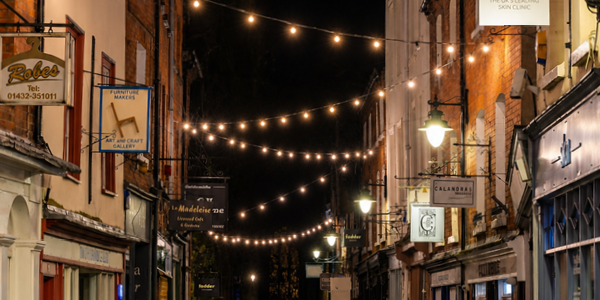
Narrow streets can offer a particularly atmospheric setting for festive lighting.
Because the surrounding buildings are closer together, lighting can often be positioned lower and the coverage naturally feels more concentrated. There is also less open sky visible between features, meaning that even a relatively simple installation can create a strong sense of enclosure.
This makes narrow streets well suited to creating intimate, immersive environments.
Cross-street motifs, catenary lighting and suspended elements can work particularly well, while the height of surrounding buildings and the types of vehicles using the street should be considered when deciding how high to position them.
A narrower street can also benefit from repetition. Rather than relying on one large feature, repeating a motif or lighting treatment along the length of the street can create rhythm and encourage the eye to travel through the space.
The result can be a street that feels dressed as a whole, rather than simply decorated at individual points.
Wider streets present a different challenge: impact can become diluted.
A feature that feels substantial in a narrow street can suddenly look quite small when it is suspended across a much wider space. For example, a relatively small cross-street motif may not have enough visual presence to hold its own across a broad road.
There are several ways to address this.
One is to increase the size of the feature itself. Larger motifs can help fill the available space and maintain a stronger visual presence.
Another is to build up the surrounding coverage. A cross-street motif could be paired with icicle lighting, additional suspended elements or other treatments along the street, creating a more complete composition rather than relying on one feature alone.
Spacing can also influence how dense a scheme feels. With festoon lighting, for example, a 1m bulb spacing can appear relatively sparse across a wide space, while a tighter 50cm spacing creates a fuller and more continuous effect. This becomes particularly noticeable when additional motifs or decorations are incorporated into the festoon.
The objective isn't simply to add more product. It is to make sure the scale, spacing and density of the individual elements work together.
Think about visual density, not just product quantity. A well-balanced scheme can feel generous without necessarily covering every available surface.
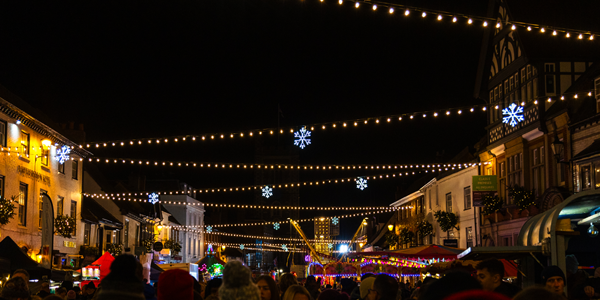
Open spaces create perhaps the biggest challenge when it comes to maintaining impact.
A lighting scheme that feels abundant within a narrow street can quickly become diluted when spread across a large square. Rather than trying to cover every part of the space equally, consider where you want people to focus their attention.
This might be a large Christmas tree, a free-standing feature, an illuminated archway or another experiential installation.
Once you have established a focal point, supporting lighting can help connect it to the surrounding space. Icicles, curtains of light, garlands and other space-filling products can provide background coverage, while smaller decorative elements can help link different areas together.
You should also consider what else happens within the space. Markets, events, outdoor seating, commercial areas and emergency access can all affect where lighting can be positioned.
Understanding how the space is used throughout the season can help ensure that the finished scheme enhances it rather than getting in the way.
People don't experience a lighting scheme from one fixed viewpoint. They approach it, walk through it, look down streets, turn corners and discover different elements along the way.
Sightlines can therefore play an important role in deciding where features are positioned.
A long street might benefit from repeated elements that draw the eye into the distance, while layered lighting can create glimpses of something further ahead, encouraging people to explore the space.
This can be particularly effective when different elements are positioned at varying heights and distances. Rather than seeing the entire scheme at once, visitors gradually discover it as they move through the destination.
In this sense, lighting isn't simply dressing a space, it can help shape how people experience it.
Think about what someone sees when they first enter the area, what catches their attention from further away and what they discover as they move closer.
One of the easiest ways for a lighting scheme to lose impact is for its features to be too small for the space.
This doesn't necessarily mean that every feature needs to be enormous. It means considering the relationship between the size of the product and the space around it.
As a starting point, measuring the available area can help when comparing products in a catalogue.
The height of existing lighting columns can also help guide the scale of pole-mounted motifs. As a general starting point, an 8m lighting column could accommodate a motif of up to around 3m in height, while a 6m column would typically suit a motif of around 2m. These proportions help ensure that the feature has enough presence without becoming visually overwhelming or sitting too low on the column.
For cross-street motifs, the width of the road and available clearance should also be considered. Allowing around 1m of space either side of the motif can provide a useful starting point when assessing the appropriate size for the available span.
Freestanding features need to be considered in three dimensions too. A Christmas tree, for example, needs enough surrounding space for its proportions to feel natural rather than cramped.
The key is to consider proportion rather than simply product size.
A feature can be perfectly attractive in isolation but lose its impact if it is placed somewhere much larger than it was designed for.
When it comes to creating a comfortable outdoor environment, lighting the wider surroundings can be just as important as lighting the path itself.1
You don't always need to start from scratch.
Existing infrastructure can provide a useful framework for a festive lighting scheme, and understanding what is already available can open up a surprising number of possibilities.
Lighting columns can support cross-street motifs or pole-mounted features. Existing catenary wires can provide the foundations for suspended displays. Trees can become focal points or form repeated illuminated avenues, while existing features such as roundabouts can provide opportunities for larger installations.
Working with what is already there can also help make a budget go further.
Instead of trying to introduce infrastructure across an entire destination, you can concentrate investment on the elements that will make the greatest difference and build the scheme around the existing assets.
The architecture and character of a place should also influence the design direction.
A historic town centre might suit a more traditional approach, using classic shapes, warm white lighting and designs that complement the surrounding buildings.
Elsewhere, a more contemporary or playful scheme might deliberately contrast with the architecture to create something unexpected.
Neither approach is necessarily right or wrong. The important thing is deciding what you want the lighting to contribute to the identity of the destination.
Does it need to blend in and enhance what's already there? Or is the intention to create a bold seasonal transformation?
For destinations with multiple stakeholders, agreeing this direction early can help create a more cohesive scheme. It gives everyone a shared understanding of what the lighting is trying to achieve before individual products are selected.
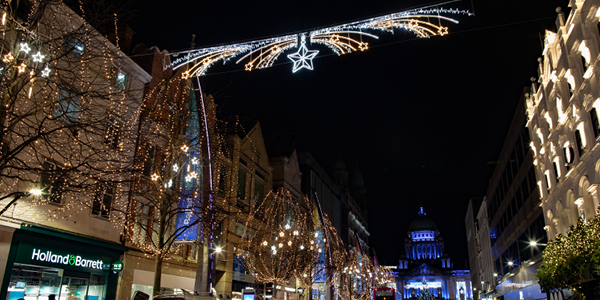
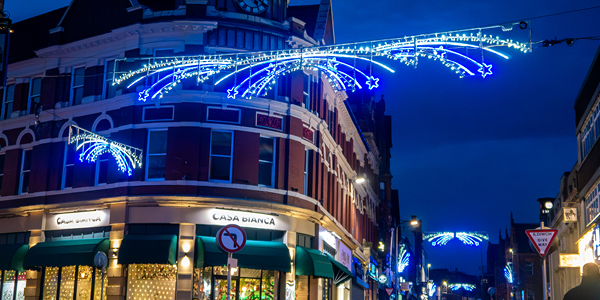
Budget will always influence what is possible, but a limited budget doesn't necessarily mean that every feature needs to be made smaller.
In a large space, several undersized features can sometimes have less impact than a smaller number of appropriately scaled focal points supported by more cost-effective background coverage.
Space-filling products such as icicles, curtains of light and garlands can help create coverage, while animated lighting can add movement and draw attention without necessarily requiring a huge feature.
It can also be worth considering where you need the greatest impact.
A destination might use a consistent, relatively simple treatment as its wider coverage, then concentrate more of its budget on key areas where people naturally gather.
The goal isn't to make everything equally impressive. It's to make the overall scheme feel intentional.
There is no single product or formula that works for every destination.
The most effective schemes start with the space itself: its scale, architecture, infrastructure, sightlines, how people use it and the atmosphere the destination wants to create.
A narrow street might lend itself to a concentrated canopy of light. A wide high street may need greater scale or denser coverage. An open square might benefit from one strong focal point surrounded by supporting elements. An avenue of trees can use repetition and perspective to create a sense of journey.
The products come afterwards.
By starting with the characteristics of the space rather than a particular product, even relatively simple schemes can feel considered, cohesive and purposeful — helping festive lighting become part of the character of a destination rather than simply something added to it.
Every space presents different opportunities. Explore our product catalogues for inspiration and discover lighting designed for a range of streets, spaces and destinations.
EXPLORE OUR PRODUCT CATALOGUES